Wednesday, March 11, 2015

US targets Andorra bank with laundering PdV funds

US targets Andorra bank with laundering PdV funds
11 Mar 2015, 5.18 pm GMT

Caracas, 11 March (Argus) — The US Treasury Department yesterday charged an Andorra-based bank of laundering around $2bn siphoned off of Venezuela´s state-owned oil company PdV.

The accusation by the department´s financial crimes enforcement network (FinCEN) that a senior manager at Banca Privada d'Andorra (BPA) laundered the funds comes amid a wider escalation of tension between Washington and Caracas.

The Venezuelan foreign ministry and PdV have not commented on the accusation.

FinCen named BPA "a foreign financial institution of primary money laundering concern" under the US Patriot Act "based on information indicating that, for several years, high-level managers at BPA have knowingly facilitated transactions on behalf of third–party money launderers acting on behalf of transnational criminal organizations."

FinCEN also accused the bank of laundering money for Russian and Chinese organized crime groups.

The money-laundering charge followed the 9 March issuance of a US executive order that implements and expands US sanctions on senior Venezuelan government officials for human rights violations and corruption.

The sanctions revoke the US visas of the officials and freeze their US assets. Around 60 Venezuelan officials have been targeted under the sanctions.

Venezuelan President Nicolas Maduro swiftly lambasted the new order, and named two of seven targeted officials as cabinet ministers. Caracas has also imposed a new visa requirement for US citizens visiting Venezuela, and ordered the curtailment of US diplomatic staff.

Some US companies with technical service contracts with PdV are pulling US employees out of Venezuela until the visa rules are clarified.

The National Andorran Finance Institute (INAF), the Spanish government entity that oversees the financial sector in Andorra, yesterday intervened on behalf of BPA and its subsidiary Banco de Madrid to guarantee operations.

In one of his now-nightly television broadcasts, Maduro yesterday requested that the national assembly grant him special powers, hinting that he may use them to suspend constitutional guarantees.

The assembly, which is controlled by the ruling PSUV party, is likely to grant the special powers today.

Venezuela´s oil-based economy is expected to contract by 7pc in 2015. Annual inflation is approaching triple digits, and shortages of basic goods are widespread.

Venezuela exported 680,000 b/d to the US in December 2014, down from 852,000 b/d in July 2014, according to most recent data from the US Energy Information Administration.

Labels: , , , ,

Wednesday, September 16, 2009

Friend in low places

I agree with this statement:
"Although this seems far-fetched perhaps the world should start to take him a little more seriously"
Vdebate reporter
Friends in low places

Sep 15th 2009 CARACAS
From Economist.com

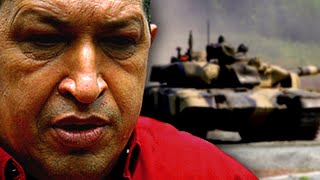
Hugo Chávez dreams of forging a new world order
Shutterstock/AFP


THE mountains and jungles of South America are not ideal terrain for tank warfare. So it is hard to envisage what role Venezuela’s president, Hugo Chávez, has in mind for the dozens of Russian tanks on his latest military shopping list. The strategic purpose of a recent tour that took him to some of the world’s least salubrious regimes is, however, easier to discern. And it led America’s State Department to give warning on Monday September 14th of a “serious challenge to stability” in the region.


Venezuela’s increasingly autocratic leader returned on Friday from a trip that took him to Libya, Iran, Algeria, Syria, Turkmenistan, Belarus and Russia, though he also found time for a visit Spain and the Venice film festival. On his jaunt he was decorated by Libya’s leader, Muammar Qaddafi, and embraced by Aleksandr Lukashenko, president of Belarus.


Apart from discussing weapons and oil with the Russians, he also courted condemnation by inviting Sudan’s pariah president, Omar al-Bashir, to Caracas, and breezily announced a nuclear co-operation deal with Mahmoud Ahmadinejad, Iran's president. Since the latter revelation was made to Le Figaro, a French newspaper, it fell to the French foreign ministry to issue a curt reminder of UN Security Council resolution 1737. This explicitly forbids the export by Iran of material from its controversial nuclear programme, which Mr Chávez supports.


The trip did much to bolster Mr Chávez’s well-earned reputation for outrageous statements. But there is method to his madness. The foreign-policy section of Venezuela’s “First Socialist Plan—2007-2013” (dubbed the “Simón Bolívar National Project”) assigns an “integral political alliance” with Iran, Syria, Belarus and Russia the highest priority outside the Latin American and Caribbean region. The rationale for this curious hotchpotch of alliances is the “common anti-imperialist interests” of those five countries—the imperialist in question being America.


Among the scheme’s aims is the strengthening of national defence and sovereignty. Not only the tanks but sophisticated anti-aircraft systems make up the order to Russia. Mr Chávez, a former lieutenant-colonel in Venezuela’s army, says these weapons will make it “very difficult for foreign aircraft to come and bomb us”. Having already spent at least $4.4 billion on Russian weapons, he has now secured an additional $2.2 billion credit-line from that country to lavish on more military hardware. Three submarines are among other possible purchases, press reports say.


In pursuit of his goal to “break North American imperialist hegemony”, the Venezuelan president has deployed to the full his prime asset—the country’s oil reserves. Thus Iran was promised 20,000 barrels of petrol a day, in potential defiance of sanctions advocated by America and despite Venezuela’s current problems supplying its own markets with fuel. Russia’s national oil consortium was also assigned a patch of the Orinoco heavy oil belt.


Closer to home, Mr Chávez’s strategic plans have come a little unstuck. He has so far failed in his quest for admittance to the Mercosur trade block. ALBA, his alliance of like-minded governments, lost a member after a coup in Honduras just over six weeks ago. And he has failed to secure regional condemnation of Colombia’s decision to allow American troops to deploy in seven military bases in the country.


Undaunted, he continues to pursue “greater world leadership”. If attention is what he is seeking, he finally seems to have got it. Last week Robert Morgenthau, a veteran New York district attorney, gave warning that Venezuela’s alliance with Iran was a threat to American interests. Bank accounts in Andorra supposedly belonging to individuals close to Mr Chávez have been frozen, reportedly because of the American Treasury Department’s suspicions of links to terrorism.


Mr Chávez is determined to play in the big leagues. His avowed calculation is that by helping to stir up trouble for America in many places simultaneously, he can bring about the collapse of “the empire”. The regimes he is so assiduously cultivating are, by this account, the nucleus of a new world order. Although this seems far-fetched perhaps the world should start to take him a little more seriously.

Labels: , , ,